Impact & Work
Leading UX transformation: shifting behavior, scaling digital products, and turning strategy into measurable outcomes.
Home Shopping Europe (HSE)
Leading UX transformation in a TV-first organization
HSE reaches 46M+ households across Germany, Austria, and Switzerland. When I joined, web and app played a secondary role in a business still driven by TV and phone-based sales. UX existed, but it operated like an internal agency, with two designers serving multiple PMs and teams, often overloaded and brought in late.
From day one, I fixed the way of working first. I moved UX from “screens on request” to clear ownership inside product teams, introduced lightweight rituals (design critique, visual quality assurance, discovery kickoffs), and earned UX a real seat at the table for revenue-critical decisions.
That foundation enabled a measurable shift from phone-first commerce to web, app, and live commerce.
Impact at a glance
Structural outcomes
Using NN/g’s UX Maturity Model, I moved the org from reactive, delivery-only UX work to a structured, embedded practice with dedicated research (self-assessed against the NN/g UX Maturity Model).
- ~2 → ~4 UX maturity shift (self-assessed vs. NN/g)
- Raised UX maturity from ~2 to ~4 (2020 → 2026) by moving from reactive delivery to a structured, team-embedded practice with clear ownership and dedicated research (self-assessed vs. NN/g).
- ~30% → ~60% Web and app share of total orders (2020 → 2026)
- Contributed to shifting the order mix from phone-based sales to web and app channels, increasing digital share from ~30% in 2020 to ~60% by 2026 as part of a broader e-commerce transformation, strengthening UX quality, trust signals, and decision-making across revenue-critical journeys.
- 2 → 8 UX designers scaled from 2 to 8 (assigned to product teams)
- Scaled UX designers from 2 to 8 and placed them inside product teams, replacing an overloaded shared-service setup with clearer ownership and fewer bottlenecks in revenue-critical journeys.
- 0 → 1 First dedicated UX Research hire, part of product discovery
- Secured approval for the first dedicated UX Research hire and brought research into product discovery and decision-making, improving decision quality and reducing late rework.
Additional outcomes
Together, these changes increased UX consistency and reduced delivery risk by making standards and decision criteria explicit across teams.
- Introduced a structured visual quality assurance ritual for the riskiest journeys, where design and engineering validate implementation against approved Figma designs before release. Design gained veto power on critical visual transgressions, reducing bug tickets by ~25% (measured via Jira tickets created).
- Initiated and co-built HSE’s first Design System (foundations, components, accessibility), reducing duplication and contributing to ~15% faster delivery across squads (measured via Jira ticket cycle time, from creation to closure).
- Led major redesigns, including during the corporate rebrand (HSE24 → HSE), modernizing high-impact journeys such as global navigation and checkout, and aligning interaction patterns across web and app to reduce friction and improve consistency at scale.
Live Shopping HELLO App
Board-backed growth initiative to validate a creator-led live commerce model beyond teleshopping
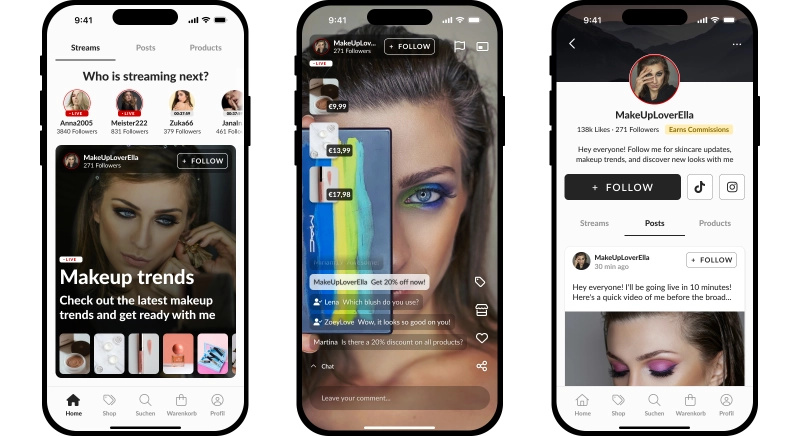
HELLO was built to validate a new growth pillar inside HSE: a creator-led, mobile-first live commerce experience aimed at younger, digital-first shoppers.
The goal was not to optimize HSE’s existing channels. It was to translate HSE’s selling DNA into a creator format and build a habit around consuming creator content, especially live streams.
Externally, it launched primarily as HELLO, with “by HSE” as an endorsement. It ran with dedicated business leadership and was executed together with HSE’s central UX, Product, and Engineering teams.
To keep quality high, we protected the riskiest journeys with explicit quality gates and visual quality assurance.
My role
Led UX strategy and quality standards from board-level validation to post-launch scaling, guiding 3 designers embedded across 3 product teams and partnering with Product/Engineering leadership on the highest-risk decisions and trade-offs.
Key insight
- By treating “Follow” as the core adoption signal, users who followed ≥1 creator were 2.3× more likely to return.
Impact
- +35% engagement vs. other HSE digital channels.
- 250+ live hours/month · 200+ creators · 100M+ viewers reached.
UX Leadership & Org Design
Scaling a UX org and increasing UX maturity in a TV-first company
From day one, I inherited a two-designer setup operating as a shared-service internal agency. I rebuilt the foundations by clarifying ownership with Product and Engineering, introducing concrete rituals (design critiques, visual quality assurance, discovery kickoffs), and moving UX into the core product decision flow, not a last-minute review. As the org grew, I scaled this way of working across squads while staying hands-on in discovery and the riskiest design decisions.
Growing the team
- Scaled the team from 2 UX designers to 8 UX designers and introduced the first dedicated UX Research role.
- Embedded designers across 8 product squads and made discovery a standard part of how teams work.
- Led hiring, onboarding, and coaching to raise quality and consistency.
Operating model
- Established regular critiques and quality reviews to reduce fragmentation and align decisions.
- Introduced shared discovery rituals with Product and Engineering (problem framing, hypotheses, and decision criteria) and used them to make trade-offs explicit before build.
- Used the Design System as a strategic asset to scale delivery across squads.
What this enabled
- More consistent UX across web and app, with faster execution through shared standards and clearer ownership.
- Better alignment on outcomes (trust, adoption, retention) and fewer costly late-stage changes because decisions moved upstream.
HSE Design System
A shared language for scale, quality, and speed
As HSE’s digital ecosystem expanded across products and teams, inconsistency and design debt slowed delivery. I initiated and helped build the company’s first Design System, giving teams shared foundations and components across web and app.
- Established shared foundations (tokens, components, accessibility standards) across web and app.
- Reduced design and development duplication through reusable components and clearer contribution rules.
- Improved consistency and accessibility, contributing to ~15% faster delivery across squads (measured via Jira ticket cycle time, from creation to closure).