AI Copywriting Tool
HSE's first AI product. Generates descriptions, SEO texts, and USPs for ~17,000 SKUs, eliminating ~€100k in annual agency costs. The hard part wasn't building it. It was proving it was good enough to ship.
Overview
An internal tool that replaced an external copywriting agency for ~17,000 SKUs. User Research was the go/no-go gate before full production rollout.
My direct contribution
User advocacy & research direction
- Acted as the user's advocate for quality: pushed the team to ask not "do users prefer AI copy?" but "is there a measurable difference in trust, accuracy perception, and purchase intent?" That is a harder bar, and the right one.
- Pushed back on the team's initial plan to validate with a preference survey; reframed it as a blind task-based study, which produces honest behaviour rather than stated preference
- Set the success criterion upfront: if the study found a significant difference, we would not ship to production. This made research a genuine gate, not a rubber stamp.
- Partnered with the User Researcher who ran the blind task-based study; defined the scope and category coverage together (fashion, jewellery, home: each has different copy conventions)
Team & collaboration
Product alignment & rollout
- Advocated with product and business stakeholders for qualitative research as the go/no-go gate; the default push was to ship and validate with A/B alone
- Aligned Product and Engineering on why research came before full production rollout, not after
- Communicated the finding to senior stakeholders: no significant difference in trust, accuracy, or purchase intent
- Handed off to Customer Intelligence for A/B confirmation; research validated direction, not sample size
Duration: 2024 · Users: Internal content teams · Scope: HSE's full product catalogue
Impact
- AI copy perceived as equivalent to human copy · Qualitative research · Later confirmed by A/B test
- Copy generated in minutes vs. ~5 days per SKU with the external agency
The Problem
Writing product copy for 17,000 SKUs is slow and expensive. Every new product required a ~5-day agency turnaround cycle. With ~3,000 new SKUs per year, that dependency cost roughly €100k annually and created a constant queue of products waiting for copy before they could go live.
The AI tool was built to remove that dependency. The business case was straightforward. The harder question was whether the output was actually good enough to put in front of customers without damaging trust or conversion.
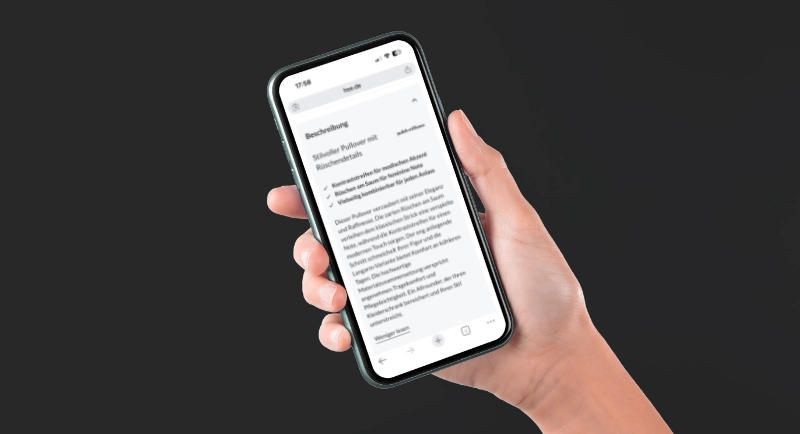
The tool works like this: a content editor opens it, enters the product details, and the tool generates a description, SEO text, and USP. The editor reviews, adjusts if needed, and approves. What previously took five days at an external agency now takes minutes internally.
Why the research design mattered as much as the finding
The natural instinct when validating AI-generated content is to ask users which version they prefer. That's the wrong question: stated preference in an evaluation context consistently overstates quality sensitivity. Users know they're being tested and give more considered answers than they would in a real purchase situation.
The User Researcher ran a blind, task-based study. Participants were shown product pages and asked to make purchase decisions, without knowing whether the copy was AI or human. The study measured trust, accuracy perception, and purchase intent indirectly, through behaviour and follow-up probing, not through direct ratings.
The finding was unambiguous: no significant difference across all three dimensions, across fashion, jewellery, and home categories. That's a harder standard to clear, and it's why the finding was credible enough to act on.
Reflection
The instinct when validating AI-generated content is to ask users which version they prefer. That instinct is wrong, and I pushed back on it. But the instinct to validate qualitatively first and quantitatively second was my own, and it was also partially wrong.
The qualitative sample was sufficient to inform a go/no-go decision. It was not sufficient to prove the finding at scale. The A/B test was the right follow-up, but it was scoped as a separate workstream rather than part of the same validation plan. If I were designing this process again, I'd scope both studies at the start: qualitative to shape the hypothesis and catch gross problems early, quantitative to confirm the finding before full production rollout.
The broader lesson is about how to frame AI research questions. For any AI system where the output replaces a human process, the question is never "do users prefer AI output." Preference in an evaluation context is not predictive of real behaviour. The question is always: does AI output produce a different outcome on the metric we care about. Framing it that way makes the research harder to design and easier to act on.
Takeaway
AI can write product copy. Research proved it, because we asked the right question, not just a convenient one. That is the difference between research as a decision input and research as a rubber stamp.